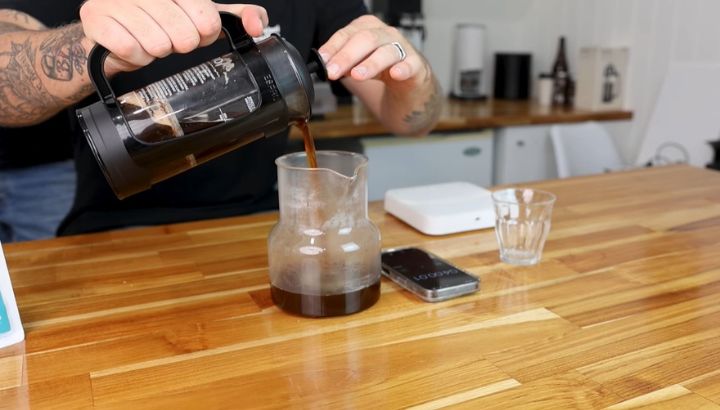
To make French press coffee, add coarsely ground coffee to the empty press at a 1:15 coffee-to-water ratio, pour hot water at 195°F to 205°F over the grounds, and steep for exactly 4 minutes before pressing the plunger down slowly.
Use a burr grinder set to coarse, a kitchen scale for accurate measurements, and filtered water just off the boil for the best extraction.
Pour the finished coffee into a separate carafe immediately after pressing to stop extraction and prevent bitterness. A properly made French press brew is full-bodied, rich, and completely sediment-controlled when done right.
Most people who own a French press end up with one of two problems: a bitter, over-extracted cup or a weak, muddy one that leaves gritty sediment in every sip. Neither outcome is inevitable. Both come from fixable mistakes in grind size, water temperature, steep time, or technique.
The French press is one of the most rewarding home brewing methods when you understand what it’s actually doing. It’s an immersion brewer, meaning the grounds steep directly in the water for a fixed time rather than passing through a filter. That contact produces a fuller body and richer flavor than drip coffee, but it also means every variable matters more.
This guide covers every decision you’ll face from bean selection to cleanup, including which French press models perform best, where most brewers go wrong, and how to get a clean, full-flavored cup every single time.
How the French Press Works
The Immersion Brewing Mechanism
A French press brews by full immersion: ground coffee sits in direct contact with hot water for the entire steep period. There’s no paper filter removing oils from the liquid, which is why French press coffee has a distinctively heavier body than drip or pour-over coffee.
After steeping, the metal plunger screen is pressed down to push the grounds to the bottom of the carafe. The screen separates grounds from liquid, but it’s coarser than a paper filter, which means some fine particles and coffee oils remain in the cup. This is intentional and is a core part of what gives French press coffee its character.
The entire extraction process is controlled by four variables: grind size, water temperature, steep time, and the coffee-to-water ratio. Change any one of these and the flavor profile of the finished cup shifts noticeably.
Key Components and What They Do
The plunger assembly consists of a metal rod attached to a spiral plate, a cross plate, and a mesh filter screen at the bottom. These three layers work together to trap grounds when pressed. The tightness of the mesh and the quality of the seal against the carafe walls determines how much sediment ends up in the cup.
The carafe in most home French presses is either borosilicate glass or stainless steel. Borosilicate glass carafes (used in models like the Bodum Chambord) are heat-resistant and let you monitor the brew visually. Double-wall stainless steel carafes (used in the Fellow Clara and Frieling Double Wall) retain heat significantly better, keeping the brew temperature stable throughout the steep without a separate warmer.
The lid sits on top of the carafe and includes the plunger rod. A well-fitted lid minimizes heat loss during steeping and keeps the brew temperature in the optimal extraction range for the full 4 minutes.
Types and Variations of French Press Brewers
Classic Glass French Press
The classic glass French press is defined by its borosilicate glass carafe and chrome or stainless steel frame. The Bodum Chambord is the benchmark model in this category, available in 3-cup (12 oz / 350 ml), 4-cup (17 oz / 500 ml), 8-cup (34 oz / 1,000 ml), and 12-cup (51 oz / 1,500 ml) sizes.
Glass models are lighter, less expensive, and easier to monitor during brewing. The tradeoff is heat retention: glass loses temperature faster than stainless steel, which can shorten your effective steep window in cold kitchens. They’re also more fragile and require careful handling, particularly during cleaning.
For most home brewers making 1 to 2 cups at a time, the 3-cup or 4-cup Bodum Chambord is the practical choice. It brews a full serving without requiring a large batch and is widely available for under $40.
Double-Wall Stainless Steel French Press
Double-wall stainless steel French presses use vacuum insulation between two steel walls to hold heat for significantly longer than glass. The Fellow Clara (24 oz / 710 ml) and the Frieling Double Wall (available in 17 oz, 23 oz, and 44 oz sizes) are the leading home models in this category.
The Fellow Clara includes a built-in blooming timer and a textured grip, making it one of the most user-friendly stainless options currently available. The Frieling uses a unique dual-screen filter system that reduces sediment better than most standard single-screen assemblies.
Stainless steel models are ideal if you brew slowly, live in a cold environment, or want your coffee to stay warm while you drink without a separate carafe or warmer. They typically cost two to three times more than comparable glass models but last significantly longer.
Travel and Compact French Press
Travel French press models like the Espro Travel Press and the Stanley French Press Travel Mug (16 oz / 473 ml) combine the brewing chamber and the drinking vessel in one insulated container. They use a finer mesh filter than standard models to reduce sediment in a portable format.
These are purpose-built for commuters and travelers who want French press quality without carrying separate equipment. Brew quality is slightly lower than a dedicated full-size press due to the compact filter assembly, but the convenience advantage is significant.
Large Capacity French Press
For households brewing 4 or more cups at a time, the Bodum Brazil (51 oz / 1,500 ml) and the Mueller French Press (34 oz / 1,000 ml) cover the large-batch category. Both use standard single-screen plunger assemblies and are available in the $20 to $35 range.
Large capacity models are efficient for households or offices but require more precise ratio scaling to avoid over-extraction. A full 51 oz batch using the correct 1:15 ratio needs approximately 95g of coarsely ground coffee, which requires a scale to measure accurately.
Comparison at a Glance
| Model | Capacity | Material | Filter Type | Best For |
|---|---|---|---|---|
| Bodum Chambord | 12 to 51 oz | Borosilicate glass | Single mesh screen | Everyday home brewing |
| Fellow Clara | 24 oz | Double-wall stainless | Single mesh screen | Heat retention, design |
| Frieling Double Wall | 17 to 44 oz | Double-wall stainless | Dual mesh screen | Low sediment, durability |
| Espro Travel Press | 16 oz | Stainless steel | Micro-filter screen | Travel, portability |
| Bodum Brazil | 51 oz | Borosilicate glass | Single mesh screen | Large batch, budget |
What You Need Before You Start
Coffee Bean and Roast Selection
Use whole coffee beans and grind fresh immediately before brewing. French press benefits more from fresh grinding than almost any other home method because the coarse grind used here has a higher surface area exposed to air, meaning pre-ground coffee goes stale faster and tastes flat in the cup.
Medium and dark roasts are the traditional choice for French press. They produce the rich, chocolatey, full-bodied flavor that makes French press coffee worth the extra process steps compared to drip. Light roasts work well in a French press too, particularly for single-origin beans where you want to highlight floral or fruit notes, but they require slightly lower water temperature (around 195°F) and a closer eye on steep time.
Avoid using robusta-heavy blends in a French press. Without a paper filter to absorb oils, robusta’s naturally higher bitterness and rubber-like off-notes come through more clearly than they do in filtered methods.
Grinder Selection and Grind Setting
A burr grinder is essential for French press. The coarse, uniform grind required for a 4-minute immersion steep cannot be reliably produced by a blade grinder. Blade grinders create an inconsistent mix of coarse chunks and fine powder, and those fines over-extract immediately, adding bitterness and increasing sediment.
On common home burr grinders, target these coarse settings: Baratza Encore at 25 to 28 out of 40, Breville Smart Grinder Pro at 25 to 30 out of 60, Comandante C40 at 30 to 35 clicks from zero. The grounds should look like coarse breadcrumbs, larger than drip coffee but not quite as large as cold brew grind.
If a blade grinder is your only option, pulse in 1-second bursts and stop at the coarse sea salt stage. Sift out visible powder through a fine strainer before brewing to reduce bitterness caused by over-extraction of fines.
Water Temperature and Volume
Use water at 195°F to 205°F (90°C to 96°C), which is just off a full boil. Boil your kettle and let it sit for 30 to 45 seconds before pouring. A gooseneck kettle with a built-in thermometer, like the Fellow Stagg EKG (0.9 liter capacity, 1200W heating element) or the Bonavita Variable Temperature Kettle (1.0 liter, 1000W), gives you precise temperature control without guessing.
Water that’s too hot extracts bitter compounds aggressively. Water that’s too cool under-extracts and produces a flat, thin cup. The 195°F to 205°F range hits the extraction sweet spot for the full range of desirable flavor compounds in medium and dark roasts.
Use filtered water for the best results. Tap water with high mineral content or strong chlorine presence produces off-notes that are amplified in immersion brewing compared to drip methods.
Step-by-Step French Press Brewing Guide
Step 1: Preheat the French Press
Pour hot water into the empty French press carafe, swirl it around, and discard. This preheating step raises the carafe wall temperature by several degrees, which slows heat loss during the steep and keeps your brew in the correct extraction temperature range for the full 4 minutes.
For a glass carafe, preheating also reduces thermal shock risk. Pouring near-boiling water directly into a cold glass carafe stresses the material, particularly in thinner-walled budget models.
Step 2: Measure and Grind Your Coffee
Weigh your coffee on a kitchen scale accurate to 1g. The standard French press ratio is 1:15 coffee to water by weight. For a full 34 oz (1,000 ml) Bodum Chambord, that means 66g of coffee to 1,000 ml of water.
Grind immediately before brewing at the coarse setting appropriate for your model. Set the ground coffee aside in a small bowl while you prepare the water. Don’t grind and then let it sit for 10 minutes before brewing; oxidation starts immediately after grinding and affects flavor noticeably even within a few minutes.
Step 3: Add Coffee and Start Your Timer
Discard the preheat water and add the measured grounds to the empty carafe. Start your timer as soon as you begin pouring water over the grounds. The steep window starts from the first contact between water and coffee.
Pour about twice the weight of your coffee in water first (for a 66g dose, pour roughly 130 ml initially). This initial pour saturates all the grounds evenly before you add the remaining water, similar to a bloom in pour-over brewing.
Step 4: Pour the Remaining Water and Stir
After the 30-second bloom, pour the remaining water slowly and evenly over the grounds. Fill to about 1 inch below the top of the carafe to leave room for the plunger assembly.
Give the slurry one gentle stir with a long spoon or chopstick to fold any floating grounds into the water. Place the lid on the carafe with the plunger pulled all the way up, but do not press yet. The lid minimizes heat loss during the remaining steep time.
Step 5: Steep for 4 Minutes
Let the coffee steep undisturbed for 4 minutes total from your first pour. Most medium and dark roast coffees extract fully and cleanly in this window at the 1:15 ratio and 200°F water temperature.
If your finished cup regularly tastes bitter, try reducing steep time to 3 minutes 30 seconds. If it regularly tastes weak, try extending to 4 minutes 30 seconds. Adjust one variable at a time and keep brief notes on what changes.
Step 6: Press and Pour Immediately
When your timer hits 4 minutes, press the plunger down slowly and steadily over 20 to 30 seconds. Apply even, gentle pressure straight down. If the plunger meets significant resistance, your grind is too fine. If it drops with almost no resistance, your grind is too coarse.
Pour the finished coffee immediately into a separate carafe or serving vessel. Do not let the coffee sit in the French press after pressing. The grounds sitting at the bottom continue to extract even after pressing, and within 5 to 10 minutes the coffee will over-extract and turn noticeably bitter.
Common Mistakes and How to Fix Them
Leaving Coffee in the Press After Brewing
The most common French press mistake is treating the press like a serving carafe. Coffee left in contact with the pressed grounds continues extracting, and within 10 minutes the cup goes from rich and balanced to harsh and bitter.
Always pour immediately after pressing. A glass or stainless steel serving carafe keeps the finished coffee warm without continuing extraction. This single habit change fixes over-extraction for the majority of French press users.
Using Too Fine a Grind
A grind that’s too fine produces excess sediment in the cup and over-extracts quickly, adding bitterness that no amount of dilution fully corrects. If your French press plunger is difficult to press and your coffee tastes harsh, the grind is the likely cause.
Move your burr grinder one or two settings coarser and test again. Correct coarse grind should allow the plunger to descend with moderate, consistent resistance over the full 20 to 30 second press stroke.
Wrong Water Temperature
Using boiling water straight from the kettle at 212°F (100°C) scorches the grounds and extracts bitter compounds at a rate that overwhelms the desirable flavors. Using water that’s cooled too far below 195°F produces a flat, under-extracted cup with thin body.
Let your kettle rest for 30 to 45 seconds after boiling before pouring. If you have a variable temperature kettle like the Fellow Stagg EKG or Bonavita Variable Temperature, set it to exactly 200°F and eliminate the guesswork entirely.
Skipping the Bloom
Adding all the water at once without a bloom pour means some grounds, particularly in freshly roasted beans, stay dry or poorly saturated in the early steep. Freshly roasted coffee off-gasses CO2 that resists water absorption, and a 30-second bloom releases that gas before the main pour.
Use roughly twice the coffee weight in water for the bloom pour, wait 30 seconds, then add the remaining water. This ensures full, even saturation from the start and produces a noticeably more even extraction.
Pro Tips for Better French Press Coffee
Use a Scale, Not a Scoop
Coffee scoops measure by volume, which varies significantly across grind sizes and bean densities. A scoop of coarsely ground dark roast weighs less than a scoop of finely ground light roast. Using a scale removes that variable entirely and gives you a repeatable ratio every batch.
A basic kitchen scale costs under $15 and makes the single biggest improvement to consistency across all home brewing methods. The 1:15 ratio is your anchor point. Once you’ve dialed it in for your beans and press, you can scale the batch up or down precisely by changing only the total water volume.
Double-Filter for a Cleaner Cup
If sediment in the cup bothers you, pour the finished coffee through a fine-mesh strainer or a paper filter placed over your serving carafe. This removes fine particles that pass through the plunger screen and produces a significantly cleaner cup with less gritty texture.
This technique gives you the full body and oil content of French press brewing with the clarity more typical of pour-over. It adds about 2 minutes to the process but is worth it for anyone who dislikes the texture of unfiltered French press coffee.
Rinse the Filter Screen Before Use
Before adding coffee, rinse the plunger assembly under hot water for 10 seconds. This removes any residual oils or stale coffee particles from the previous brew and preheats the metal components of the plunger assembly simultaneously.
Old coffee oils on the filter screen go rancid quickly and add an off-flavor to fresh batches. A quick rinse takes 10 seconds and is the simplest maintenance habit for consistently better-tasting coffee.
Maintenance and Cleaning
After Every Use
Disassemble the plunger assembly completely after every brew: unscrew the mesh screen, the cross plate, and the spiral plate from the plunger rod. Rinse each component separately under warm running water to remove all coffee residue and oils.
Do not let spent grounds dry inside the carafe. Dried grounds are significantly harder to clean and leave residue on the glass or steel walls that affects the flavor of subsequent brews. Rinse the carafe immediately after pouring out the coffee.
Weekly Deep Clean
Once a week, wash all plunger components with warm soapy water and a soft brush. Pay particular attention to the mesh screen, where fine coffee particles and oils accumulate between the layers. Hold the screen up to the light after washing to confirm no clogged areas remain.
For glass carafes, wash with warm soapy water and a bottle brush that reaches the base. Most glass French press carafes are dishwasher safe on the top rack, though hand washing preserves the carafe finish and extends the life of rubber gaskets.
Replacing Worn Components
The mesh screen is the most wear-prone component of a French press. A stretched, torn, or distorted screen allows excessive fine particles into the cup and reduces plunger resistance. Replacement screens for the Bodum Chambord and most standard 4-inch diameter presses cost under $10 and are widely available.
Replace the screen when you notice significantly increased sediment in the cup despite using a correct coarse grind, or when the plunger moves with noticeably reduced resistance even at a medium grind setting. Keeping a spare screen on hand prevents a worn filter from ruining your morning brew.
Frequently Asked Questions
How long should I steep French press coffee?
The standard French press steep time is 4 minutes for medium and dark roast coffee at a 1:15 ratio and 200°F water temperature. This window extracts the full range of desirable flavor compounds without crossing into harsh over-extraction territory.
If your coffee tastes bitter at 4 minutes, try reducing steep time to 3 minutes 30 seconds or adjusting your grind one setting coarser. If it tastes weak or thin, extend the steep to 4 minutes 30 seconds or go one setting finer on your grinder. Adjust one variable per batch so you can isolate what’s actually changing the flavor.
What is the correct coffee-to-water ratio for French press?
The standard French press ratio is 1:15 coffee to water by weight, meaning 1 gram of coffee for every 15 grams of water. For a full 34 oz (1,000 ml) press, that means approximately 66g of coffee. For a smaller 17 oz (500 ml) press, use around 33g.
Some brewers prefer a stronger 1:12 ratio for a bolder, more intense cup. The 1:15 ratio is the reliable starting point that works for most medium and dark roasts. Always measure by weight using a kitchen scale rather than by volume, since ground coffee density varies significantly across roast levels and origins.
What grind size is best for French press?
French press requires a coarse grind, roughly the size of coarse breadcrumbs or slightly smaller than cold brew grind. On a Baratza Encore, target setting 25 to 28 out of 40. On a Breville Smart Grinder Pro, use 25 to 30 out of 60.
A grind that’s too fine over-extracts quickly and adds bitterness and excess sediment. A grind that’s too coarse under-extracts and produces a thin, weak cup with the plunger offering almost no resistance. The correct coarse grind should allow the plunger to descend with firm, even pressure over 20 to 30 seconds without forcing or jamming.
Why is my French press coffee bitter?
Bitterness in French press coffee comes from three main causes: a grind that’s too fine, water that’s too hot, or coffee left sitting in the press after brewing. The most common cause is leaving finished coffee in the carafe after pressing, which continues extraction even with the plunger down.
Pour immediately after pressing into a separate carafe. Then check your grind: it should look like coarse breadcrumbs, not drip coffee grounds. Finally, verify your water temperature is between 195°F and 205°F rather than at a full rolling boil. Address these three points in order and bitterness typically resolves within one or two batches.
Why is there so much sediment in my French press coffee?
Sediment in French press coffee comes from fine particles passing through the plunger mesh screen. The most common cause is a grind that’s too fine, which produces an excess of fine particles that pass through even a good quality mesh screen.
Coarsen your grind one setting at a time until sediment reduces. Also check the condition of your plunger screen: a stretched or worn screen allows fines through that a fresh screen would trap. For a completely sediment-free cup, pour the finished coffee through a paper filter over a serving carafe after pressing. This adds 2 minutes but produces a significantly cleaner cup.
Can I use pre-ground coffee in a French press?
Yes, but results are significantly better with freshly ground whole beans. Pre-ground coffee sold for drip brewing is typically too fine for French press, which leads to over-extraction, bitterness, and excess sediment.
If you use pre-ground coffee, look for products labeled specifically as “coarse grind” or “French press grind.” Store it in an airtight container and use it within one to two weeks of opening to minimize oxidation. For occasional use this is entirely workable, but if you drink French press regularly, investing in a burr grinder and whole beans will produce a noticeably better cup within the first week of use.
Does French press coffee have more caffeine than drip coffee?
French press coffee typically contains slightly more caffeine per cup than standard drip coffee when brewed at similar ratios, primarily because the immersion brewing method and lack of paper filtration allow more total extraction from the grounds.
However, the difference is relatively small and varies significantly by bean origin, roast level, and brew ratio. The 1:15 ratio used for French press is comparable to standard drip ratios. The more noticeable difference is body and flavor intensity rather than caffeine content. If you’re specifically managing caffeine intake, the ratio and bean volume matter more than the brewing method itself.
Is French press coffee bad for cholesterol?
French press coffee contains cafestol and kahweol, two diterpene compounds found in coffee oils that have been shown in clinical studies to raise LDL cholesterol when consumed regularly in significant amounts. These compounds are present in French press coffee because there’s no paper filter to absorb the oils, unlike drip or pour-over coffee.
For most healthy adults drinking one to two cups per day, the impact is minimal. People with existing high cholesterol or cardiovascular concerns should consult their doctor about daily French press consumption. Switching to a paper-filtered method eliminates most of the dietary diterpene exposure while retaining similar caffeine and flavor benefits.
Which French press is best for home use?
For most home brewers, the Bodum Chambord in 34 oz (1,000 ml) capacity is the best starting point: proven design, widely available replacement parts, solid borosilicate glass carafe, and a price point under $40. It handles everything from single cups to multi-serving batches.
For heat retention and durability, the Fellow Clara (24 oz) is the top mid-range upgrade with better insulation and a more refined filter assembly. For maximum sediment reduction, the Frieling Double Wall dual-screen design outperforms all standard single-screen models. Choose the Bodum Chambord to start, upgrade to the Fellow Clara or Frieling once you’re brewing consistently.
Conclusion
Great French press coffee comes down to five things: a coarse burr grind, water at 195°F to 205°F, the correct 1:15 ratio, a clean full 4-minute steep, and pouring immediately after pressing. Every common problem, bitterness, sediment, weak flavor, traces directly to one of these five variables being off.
The equipment investment required is minimal. A burr grinder in the $50 to $100 range, a basic kitchen scale, a decent kettle, and a well-built press like the Bodum Chambord is everything you need to produce café-quality results at home.
For anyone learning how to make French press coffee for the first time, start with the Bodum Chambord 34 oz, a Baratza Encore at setting 26, 66g of medium roast beans to 1,000 ml of 200°F filtered water, and a 4-minute steep. Nail those numbers once and you’ll repeat them consistently. From there, every adjustment you make is a refinement rather than a fix.