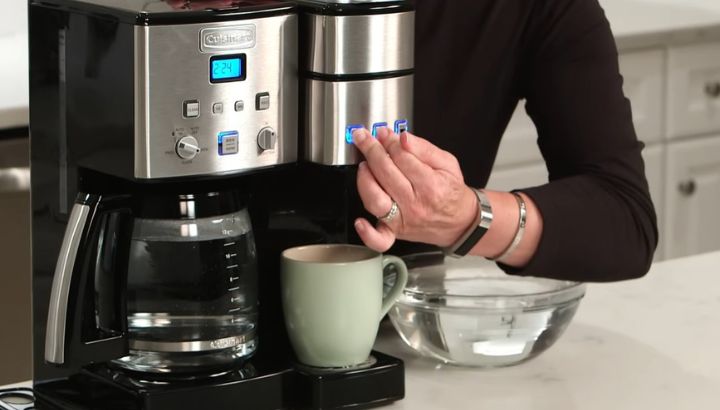
To clean a Cuisinart coffee maker, run the self-clean cycle by filling the reservoir with a 1:2 ratio of white vinegar to water, pressing and holding the Clean button until the light activates, then allowing the full cleaning cycle to complete before running two fresh water rinse cycles.
For models without a self-clean button, manually run a 50/50 vinegar-water solution through a full brew cycle, pause halfway for 30 minutes to soak the internal components, complete the cycle, then flush with two full reservoirs of fresh water.
Clean removable parts including the carafe, filter basket, and water reservoir with warm soapy water weekly, replace the charcoal water filter every 60 days, and descale the internal system every 1 to 3 months based on water hardness and usage frequency.
If your Cuisinart coffee maker is brewing slower than usual, producing coffee that tastes bitter or flat, or showing a persistent Clean light that won’t turn off even after running a cleaning cycle, the machine isn’t malfunctioning. It needs a proper cleaning performed correctly from start to finish.
Cuisinart machines are engineered with precision heating elements, narrow internal water lines, and spray head systems that distribute water evenly over coffee grounds. All of these components accumulate mineral scale, coffee oil residue, and bacterial buildup over hundreds of brew cycles, and that accumulation directly degrades both the machine’s performance and the quality of every cup it produces.
This guide covers the complete cleaning process for every major Cuisinart coffee maker model, including the DCC-3200, SS-15, DGB-900BC, DTC-975BKN, and Precision Brewer, with step-by-step instructions for both the self-clean function and manual cleaning, common mistakes that prevent a thorough result, and the maintenance schedule that keeps Cuisinart machines performing at their best long term.
How Cuisinart Coffee Makers Work and Why They Get Dirty
The Internal Brew Path
Cuisinart drip coffee makers operate by drawing cold water from the water reservoir through a tube connected to the heating element. The heating element heats the water to between 195°F and 205°F before it travels upward through the dip tube to the spray head, which distributes it evenly over the coffee grounds in the filter basket.
The brewed coffee drips through the filter basket into either a glass carafe on a warming plate or a thermal carafe depending on the model. Every component in this path, from the reservoir outlet to the spray head holes, is exposed to minerals, coffee oils, and organic material with every single brew cycle.
Cuisinart machines that are used daily and never cleaned accumulate enough mineral scale on the heating element within 3 to 6 months to measurably reduce brew water temperature. Lower brew temperature means under-extraction, which produces weak, sour, or flat-tasting coffee regardless of bean quality or grind size.
The Self-Clean System Explained
Most current Cuisinart models including the DCC-3200, DCC-3400, and SS-15 include a dedicated Clean button that automates the descaling cycle. When activated with a vinegar-water solution in the reservoir, the self-clean function runs the solution through the brew path in stages with built-in pause intervals that allow the acid to soak the heating element and water lines more effectively than a standard continuous brew cycle.
The Clean light on Cuisinart machines is triggered by a brew counter built into the machine’s programming. It activates after approximately 30 brew cycles as a reminder rather than as a real-time measurement of actual scale accumulation. In hard water areas, the machine may need cleaning before the light activates; in soft water areas with filtered water, the counter may trigger before cleaning is actually necessary.
Understanding that the Clean light is counter-based rather than sensor-based helps you establish a cleaning schedule based on your actual water quality rather than simply waiting for the light.
Cuisinart Models and Their Specific Cleaning Requirements
Cuisinart DCC-3200 and DCC-3400
The Cuisinart DCC-3200 (14-cup, 1500W heating element) and DCC-3400 (14-cup with thermal carafe) are among the most widely used Cuisinart home models. Both feature the self-clean button on the front control panel and a charcoal water filter housed in a filter holder inside the water reservoir.
The DCC-3200 has a glass carafe with a warming plate that maintains temperature after brewing. The DCC-3400 uses a stainless steel thermal carafe that holds heat through insulation rather than a warming plate. The thermal carafe requires a separate vinegar soak internally since the narrow-necked design makes physical brushing difficult.
Both models have a removable spray head that unscrews counterclockwise from the underside of the brew head cover. Removing and soaking it separately in vinegar every month ensures the distribution holes stay clear and unobstructed.
Cuisinart SS-15 and SS-20
The Cuisinart SS-15 and SS-20 are dual-function models that combine a 12-cup drip carafe brewer with a single-serve pod side in one unit. They have two entirely separate brew paths: the carafe side uses a standard filter basket and spray head system, while the single-serve side uses a pod holder and a separate water distribution system.
Both brew paths require independent cleaning attention. Running a vinegar cycle through the carafe side does not descale the single-serve side, and vice versa. Users who primarily use one side often neglect the other, and scale builds up in the unused path just as quickly from mineral-heavy water sitting in the shared reservoir.
The shared 60 oz water reservoir on the SS-15 is particularly important to keep clean and filter-equipped since its water supplies both brew systems.
Cuisinart DGB-900BC Grind and Brew
The Cuisinart DGB-900BC features an integrated conical burr grinder that feeds freshly ground coffee directly into the brew basket. The grinder adds a cleaning dimension that standard drip models don’t have: the grinder chamber, grind chute, and brew basket all accumulate coffee oils and grounds that require regular physical cleaning alongside the standard vinegar descaling cycle.
The water path cleaning process for the DGB-900BC follows the same self-clean procedure as other Cuisinart models. The grinder mechanism, however, must never have water or vinegar run through it. Clean the grinder chamber with a dry brush after every 5 to 7 uses and wipe the chute with a dry cloth weekly.
Coffee oils in the grinder turn rancid within days at room temperature and impart a stale, bitter taste to freshly ground beans if the grinder is left uncleaned.
Cuisinart Precision Brewer (CT, Thermal, and Carafe)
The Cuisinart Precision Brewer series, including the CBT-500, CPO-850, and CPO-800, are Cuisinart’s SCA-certified (Specialty Coffee Association) machines designed to brew at the optimal 205°F water temperature with a controlled 6-minute brew time. Their higher-precision heating systems make them more sensitive to scale buildup than budget models.
The Precision Brewer models have a showerhead design rather than a standard spray head, distributing water through a wider pattern over the coffee bed. This showerhead is removable on most variants and should be soaked in vinegar monthly to prevent scale accumulation in the distribution channels.
Scale on the Precision Brewer’s heating element causes the machine to drop below its certified brew temperature, directly undermining the SCA compliance that makes it worth the higher price point.
| Model | Capacity | Self-Clean Button | Filter Type | Special Cleaning Note |
|---|---|---|---|---|
| DCC-3200 | 14-cup glass carafe | Yes | Charcoal cartridge | Remove spray head monthly |
| DCC-3400 | 12-cup thermal carafe | Yes | Charcoal cartridge | Soak thermal carafe separately |
| SS-15 | 12-cup + single-serve | Yes (both sides) | Charcoal cartridge | Clean both brew paths independently |
| DGB-900BC | 12-cup with burr grinder | Yes | Charcoal cartridge | Clean grinder separately, never wet |
| Precision Brewer CBT-500 | 10-cup thermal | Yes | Charcoal cartridge | Monthly showerhead soak critical |
| SS-20 | 12-cup + single-serve | Yes (both sides) | Charcoal cartridge | High-use model, clean every 4 weeks |
What You Need Before You Start Cleaning
Cleaning Supplies Checklist
You need white distilled vinegar (standard 5% acidity), fresh filtered water, a soft bottle brush sized for the carafe and reservoir, dish soap, a small cleaning brush or toothbrush for the spray head and filter basket holes, and a clean dry cloth for the warming plate and exterior.
Do not use cleaning vinegar (6% to 10% acidity) at full concentration in Cuisinart machines. The higher acidity can degrade the rubber gaskets and internal plastic tubing over time with repeated use. Standard 5% white distilled vinegar provides the correct acid concentration for safe and effective Cuisinart descaling.
Avoid abrasive scrubbing pads on any Cuisinart surface, including the glass carafe, warming plate, and reservoir interior. Scratches in the glass carafe trap coffee oils and residue, and scratches on the warming plate damage the non-stick coating that protects it from corrosive coffee drip buildup.
Removing and Replacing the Water Filter
The Cuisinart charcoal water filter inside the reservoir must be removed before any vinegar cleaning cycle. Vinegar saturates the activated charcoal permanently and causes it to release absorbed minerals and contaminants back into the water during subsequent brews.
To remove the filter, lift the filter holder from the reservoir wall and pull the charcoal cartridge out of its housing. Store it in a cup of cold water while descaling to keep it from drying out if it’s still within its useful life. If the filter is due for replacement (every 60 days or 60 reservoir refills), discard it and install a fresh cartridge after the rinse cycles are complete.
A fresh Cuisinart water filter cartridge should be soaked in cold water for 15 minutes before installation and rinsed under cold running water for 10 seconds. This pre-soak activates the charcoal and flushes loose carbon particles that would otherwise darken the first few cups.
Step-by-Step: How to Clean Cuisinart Coffee Maker Using the Self-Clean Function
Step 1: Wash All Removable Components First
Before running any internal cleaning cycle, remove and manually wash the filter basket, filter basket holder, carafe, and water reservoir. These parts accumulate coffee oils and grounds that the self-clean cycle doesn’t address since it only treats the internal water path.
Wash each component with warm soapy water and a soft brush. Pay particular attention to the underside of the filter basket where coffee oils concentrate, the carafe spout where dried coffee residue builds up, and the bottom interior of the water reservoir where mineral sediment settles over time.
Rinse all components thoroughly and allow them to air dry or dry with a soft cloth before reassembling. Soap residue in the filter basket or reservoir will contaminate the cleaning cycle and leave a detergent taste in subsequent brews.
Step 2: Clean the Spray Head
Locate the spray head on the underside of the brew head cover above the filter basket. On most Cuisinart models including the DCC-3200 and Precision Brewer series, it unclips or unscrews with a counterclockwise turn.
Soak the spray head in undiluted white vinegar for 15 to 20 minutes. After soaking, use a toothpick or small brush to clear each of the distribution holes individually. Scale deposits in these holes restrict water flow and create uneven saturation of the coffee bed, which causes channeling and under-extraction even in a perfectly dosed and ground brew.
Rinse the spray head under warm running water and reinstall it before proceeding to the self-clean cycle. A clear spray head distributes water evenly across the full surface of the coffee grounds, which is the foundation of a well-extracted cup.
Step 3: Prepare and Add the Vinegar Solution
Fill the water reservoir to its maximum capacity with a solution of one part white distilled vinegar to two parts cold water. For the DCC-3200’s 14-cup reservoir (approximately 70 oz), that means roughly 23 oz of vinegar and 47 oz of water.
Cuisinart’s recommended ratio for the self-clean function is 1:2 vinegar to water rather than the equal 50/50 ratio used for manual cleaning without a self-clean pause. The self-clean function compensates for the lower concentration with its built-in pause-and-soak programming.
Do not add a paper or permanent filter to the filter basket and do not add coffee grounds. Place the empty carafe in its position on the warming plate so the cleaning solution collects there rather than dripping onto the counter.
Step 4: Activate the Self-Clean Cycle
Press and hold the Clean button for approximately 3 seconds until the Clean light stays solid rather than flashing. On the DCC-3200 and DCC-3400, the Clean button is located on the front control panel to the right of the display. On the SS-15, both brew sides have independent clean functions accessible through their respective control panels.
The self-clean cycle takes approximately 60 minutes to complete on most Cuisinart models. The machine pauses automatically partway through the cycle to allow the vinegar solution to soak the internal components, then resumes and completes the remaining brew passes.
Do not interrupt the cycle once started. Opening the lid, removing the carafe, or pressing buttons during the self-clean cycle can reset the cleaning sequence and require restarting from the beginning.
Step 5: Complete the Cycle and Run Rinse Cycles
When the self-clean cycle finishes, the Clean light will turn off and the machine will return to its standby state. Discard the vinegar solution from the carafe and immediately wash the carafe with warm soapy water to prevent vinegar residue from drying on the glass.
Fill the reservoir to maximum capacity with fresh filtered water. Place the empty carafe back in position and run a full standard brew cycle with no filter or coffee. This first rinse cycle flushes the majority of vinegar residue from the heating element, dip tube, and spray head.
Run a second complete fresh water rinse cycle immediately after the first. After the second rinse, smell the output water in the carafe. No vinegar odor should be detectable. If any vinegar smell remains, run a third rinse cycle before reinstalling the water filter and brewing coffee.
Step 6: Reinstall the Water Filter and Test
After the final rinse cycle, install a fresh charcoal water filter cartridge into the filter holder inside the reservoir. Slide the holder back onto the reservoir wall clip and ensure it’s fully seated so water passes through the filter rather than bypassing it.
Run a test brew with fresh filtered water and your regular coffee to confirm the self-clean cycle resolved any performance issues. A successfully cleaned Cuisinart machine brews noticeably faster, produces a fuller carafe, and delivers coffee at a higher temperature than before cleaning.
Manual Cleaning Method for Models Without Self-Clean
Running a Manual Vinegar Cycle
For older Cuisinart models without a self-clean button, fill the reservoir with a 50/50 vinegar-to-water solution and start a normal brew cycle. When approximately half the solution has passed through and begun filling the carafe, pause the machine by pressing the brew button.
Allow the vinegar solution to sit inside the machine’s water lines and heating element for 30 minutes. This manual soak compensates for the absence of the automated pause function in the self-clean cycle. Thirty minutes of acid contact time is the minimum needed to dissolve moderate mineral scale from the heating element surface.
After 30 minutes, resume the brew cycle and let it complete fully. Run two full fresh water rinse cycles before reinstalling the water filter and returning to normal brewing.
Cleaning the Thermal Carafe Separately
The DCC-3400 and Precision Brewer Thermal models use insulated stainless steel thermal carafes that require internal soaking rather than standard brush washing. Fill the carafe to halfway with undiluted white distilled vinegar and let it sit for 20 minutes.
After soaking, add hot water to the carafe and shake gently, then empty and rinse with hot water three times. The vinegar soak loosens coffee oil film from the stainless interior walls without scratching the surface. Do not put the thermal carafe in the dishwasher since high-heat cycles can damage the vacuum seal between the carafe walls and reduce its thermal retention performance.
Common Mistakes and How to Fix Them
Leaving the Water Filter In During Cleaning
Leaving the charcoal water filter cartridge installed in the reservoir during a vinegar cleaning cycle is the most common Cuisinart cleaning mistake and one of the most damaging. The activated charcoal absorbs acetic acid during the cleaning cycle and then releases it slowly into the water supply over dozens of subsequent brews.
Always remove the filter before adding vinegar to the reservoir, store it in cold water during the cycle, and install a fresh cartridge after the rinse cycles are complete. If you accidentally ran a cleaning cycle with the filter installed, discard that filter and run an additional two rinse cycles before installing a new one.
Ignoring the Clean Light for Months
The Clean light activates based on a brew counter rather than actual scale measurement, but ignoring it for months allows deposits to harden and bond more firmly to the heating element surface. Light monthly scale is easy to dissolve with a standard vinegar cycle. Deposits left for 6 months or more often require two consecutive cleaning cycles to fully clear.
If the Clean light remains on after completing a full self-clean cycle and two rinse cycles, the machine likely has heavy scale accumulation requiring a second immediate cleaning pass with fresh vinegar solution before the rinse cycles.
Not Cleaning the Spray Head
Running self-clean cycles without periodically removing and soaking the spray head results in progressively uneven water distribution over the coffee grounds regardless of how clean the internal water lines are. The spray head holes are small enough to become partially blocked by mineral deposits within 2 to 3 months in hard water areas.
Remove and soak the spray head in undiluted vinegar for 15 to 20 minutes every month, clearing each hole individually with a toothpick before reinstalling. This single addition to the monthly cleaning routine has a measurable impact on extraction evenness and cup flavor consistency.
Pro Tips for Better Cuisinart Performance
Use Filtered Water to Reduce Cleaning Frequency
Using pitcher-filtered water from a Brita Longlast or PUR Classic in your Cuisinart reservoir significantly reduces the mineral load entering the machine with every brew. In hard water areas where monthly self-clean cycles would otherwise be required, filtered water can extend the interval to every 2 to 3 months without any reduction in brew performance.
The Cuisinart’s built-in charcoal water filter provides an additional level of filtration, but it’s sized for reducing chlorine taste rather than removing large volumes of dissolved minerals. Pitcher filtration upstream provides the primary mineral reduction that actually extends cleaning intervals.
Replace the Water Filter on Schedule
The Cuisinart charcoal water filter has a rated life of 60 days or 60 reservoir refills, but many users leave the same filter installed for 6 months or more. An expired filter stops removing chlorine effectively and can actually begin releasing previously absorbed compounds back into the water, producing the same off-taste it was designed to prevent.
Set a recurring reminder on your phone for every 60 days as your filter replacement trigger. Replacement Cuisinart filter cartridges are available in multi-packs that reduce the per-filter cost significantly and ensure you always have a fresh cartridge on hand for post-cleaning reinstallation.
Run a Water-Only Warm-Up Cycle
Running a single water-only brew cycle (no filter, no coffee) as the first cycle each morning flushes standing water from the dip tube and spray head and brings the heating element to full operating temperature. This primes the system so the first real brew cycle reaches the optimal extraction temperature from the start rather than during the first 30 seconds of the brew.
This practice is particularly beneficial for the Cuisinart Precision Brewer series, where the SCA-certified brew temperature performance is the primary selling point. A cold-start brew cycle in any machine produces a slightly lower average brew temperature than a pre-warmed system.
Frequently Asked Questions
How do I use the Clean button on my Cuisinart coffee maker?
To use the Clean button on a Cuisinart coffee maker, first remove the water filter from the reservoir, then fill the reservoir with a solution of one part white vinegar to two parts water. Press and hold the Clean button for 3 seconds until the Clean light stops flashing and remains solid. The machine will automatically run the cleaning cycle with built-in pause intervals over approximately 60 minutes. After the cycle completes, run two full reservoirs of fresh water through standard brew cycles to flush all vinegar residue. Reinstall a fresh water filter cartridge after the final rinse cycle before returning to normal brewing.
Why is my Cuisinart Clean light still on after cleaning?
If the Clean light remains on after a full self-clean cycle and two rinse cycles, the machine either has heavy scale buildup requiring a second cleaning pass or the cleaning cycle wasn’t completed correctly. Run a second full self-clean cycle immediately with a fresh vinegar solution at the 1:2 ratio. On some Cuisinart models, the Clean light must be manually reset by pressing and holding the Clean button for 3 seconds after the rinse cycles are complete even when the machine is otherwise clean. Check your specific model’s manual for the reset procedure since it varies between the DCC-3200, SS-15, and Precision Brewer series.
How often should I clean my Cuisinart coffee maker?
Clean removable parts including the carafe, filter basket, and reservoir weekly with warm soapy water. Run a full self-clean or vinegar descaling cycle every 1 to 3 months depending on water hardness and brewing frequency. In hard water areas above 120 ppm, clean monthly. In moderate hardness areas between 60 and 120 ppm, clean every 6 to 8 weeks. Replace the charcoal water filter every 60 days regardless of cleaning schedule. Daily users need more frequent attention across all cleaning categories than occasional users. The Clean indicator light activates after every 30 brew cycles as an additional reminder but shouldn’t be your only scheduling guide.
Can I put my Cuisinart carafe in the dishwasher?
The glass carafe on models like the DCC-3200 is top-rack dishwasher safe according to Cuisinart’s official guidelines. The thermal stainless steel carafe on the DCC-3400 and Precision Brewer Thermal should be hand-washed only since dishwasher heat can compromise the vacuum seal between the carafe walls over time, reducing thermal retention performance. The filter basket and drip tray are generally top-rack dishwasher safe on most Cuisinart models. Never put the main machine body, warming plate, lid, or any component with electrical connections in the dishwasher. When in doubt, refer to your specific model’s owner’s manual for confirmed dishwasher-safe components.
What is the correct vinegar ratio for cleaning a Cuisinart?
For the Cuisinart self-clean function, use one part white distilled vinegar to two parts water. For a 14-cup DCC-3200 reservoir (approximately 70 oz), that means about 23 oz of vinegar and 47 oz of water. For manual cleaning without the self-clean function, use a 50/50 equal parts vinegar-to-water solution and include a 30-minute mid-cycle pause to compensate for the absence of the automated soak function. For machines that haven’t been cleaned in more than 6 months or have visible scale deposits, use undiluted vinegar for the first cleaning pass before switching to the standard diluted ratio for maintenance cycles.
How do I clean the Cuisinart coffee maker spray head?
Locate the spray head on the underside of the brew head cover directly above the filter basket. On most Cuisinart models including the DCC-3200 and Precision Brewer, it unclips or unscrews counterclockwise without tools. Soak the removed spray head in undiluted white vinegar for 15 to 20 minutes, then use a toothpick or small brush to clear each distribution hole individually of any mineral deposits or dried coffee residue. Rinse under warm running water and reinstall by reversing the removal process. Clean the spray head monthly in addition to running the standard self-clean cycle for consistent water distribution and even extraction.
Can I use the Cuisinart self-clean function with baking soda instead of vinegar?
Baking soda is not an effective substitute for vinegar in the Cuisinart self-clean cycle. Baking soda (sodium bicarbonate) is mildly alkaline and does not react with or dissolve calcium carbonate mineral scale the way acetic acid does. While baking soda can help neutralize coffee odors and clean organic residue, it has no meaningful descaling effect on the heating element or internal water lines. Mixing baking soda and vinegar together also cancels out the acid that makes vinegar effective for descaling. Use white distilled vinegar or a citric acid-based commercial descaling solution for the internal self-clean cycle, and reserve baking soda for manual carafe and reservoir soaking if desired.
Why does my Cuisinart coffee taste like vinegar after cleaning?
Vinegar taste after cleaning means insufficient rinse cycles were run after the self-clean or manual vinegar cycle. The internal water lines and dip tube in Cuisinart machines retain residual vinegar-flavored water that requires multiple fresh water flush cycles to fully clear. Run two additional full reservoir rinse cycles immediately and smell the output water before brewing. If vinegar odor is still present after four total rinse cycles, check that the reservoir was filled to maximum capacity for each rinse since a partially filled reservoir doesn’t flush the full length of the internal water path. Installing a fresh charcoal water filter cartridge also helps absorb remaining trace acidity before it reaches the cup.
How do I clean a Cuisinart coffee maker with a built-in grinder?
For the Cuisinart DGB-900BC and similar grind-and-brew models, the water path cleaning follows the standard self-clean procedure using the vinegar solution. The grinder requires completely separate cleaning that must never involve water or vinegar. After every 5 to 7 uses, brush the grinder chamber with the cleaning brush included with the machine or a dry pastry brush, clearing all ground coffee and oil residue from the burrs and chute. Wipe the grind chute with a dry cloth weekly. Once a month, run a small quantity of grinder cleaning tablets through the grinder mechanism to remove oils from the burr surfaces without leaving moisture that could cause clogging or mold.
Conclusion
Keeping a Cuisinart coffee maker clean isn’t complicated, but it requires addressing every component on the right schedule rather than waiting for obvious performance problems to appear. The self-clean function handles the internal water path; manual washing handles the filter basket, carafe, and reservoir; and monthly spray head soaking handles the distribution system that most cleaning guides ignore entirely.
The most common reason a well-maintained Cuisinart still produces off-tasting coffee is a water filter left in place too long or a spray head clogged with scale that no amount of internal descaling can fix. Replace the charcoal filter every 60 days, remove and soak the spray head monthly, and run the self-clean cycle every 1 to 3 months based on your water hardness.
Knowing how to clean Cuisinart coffee maker correctly from the filter to the spray head to the heating element extends machine life significantly, restores the brew temperature performance these machines are specifically engineered to deliver, and produces consistently better-tasting coffee from the same beans you’re already using. The 60 minutes a month this routine requires is the single most cost-effective maintenance investment you can make in any coffee brewing equipment.