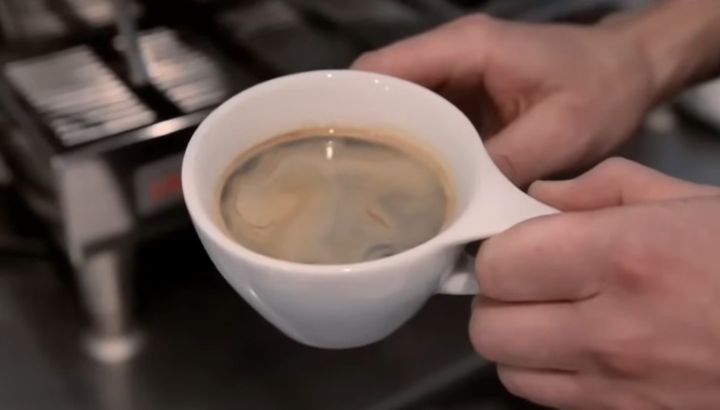
To make an Americano coffee, pull one or two shots of espresso directly into a preheated cup, then add hot water at a ratio of 1 part espresso to 2 parts hot water, producing a 6 oz to 8 oz drink with the strength of drip coffee but the distinct flavor profile of espresso.
The espresso must be pulled first and the hot water added after, not the reverse. Adding espresso into pre-filled hot water produces a Long Black, which preserves the crema layer on top and has a slightly different flavor character.
Water temperature for the added portion should be between 195°F and 205°F, matching espresso brew temperature, to avoid shocking the espresso shot and collapsing its crema prematurely before you can drink it.
If you’ve ever wondered why your homemade Americano tastes flat, thin, or nothing like what you get at a coffee shop, the answer almost always comes down to one of three things: the espresso shot quality, the water temperature, or the order in which the two components are combined. These aren’t minor details. Each one directly determines the flavor, body, and crema of the finished drink.
The Americano is deceptively simple. It contains exactly two ingredients and takes under two minutes to make once your espresso machine is warmed up. But those two ingredients need to be treated with the same precision as any other espresso-based drink, and understanding what each variable does to the finished cup is what separates a genuinely good Americano from a cup of hot, diluted disappointment.
This guide covers the complete process for making a proper Americano at home, including which machines produce the espresso quality the drink requires, how the ratio and water order affect the result, the differences between an Americano and its close relatives, and every common mistake that ruins the drink before it reaches the cup.
What an Americano Actually Is and How It Works
The Origin and Definition
The Americano has its roots in World War II when American soldiers stationed in Italy found traditional espresso too strong and intense for their taste. They diluted it with hot water to approximate the longer, milder coffee they were accustomed to drinking at home. Italian café owners began offering this modified version, and the name Caffè Americano, Italian for American coffee, stuck.
A true Americano is espresso diluted with hot water, nothing more. It is not brewed coffee, not a drip machine output, and not instant coffee dissolved in water. The espresso base gives it a flavor complexity, a body, and a crema that no other brewing method replicates, and the hot water extends it to a volume and strength comfortable for longer drinking.
The defining characteristic of a properly made Americano is that it tastes like espresso at drip coffee volume, not like drip coffee that happens to be strong. The roasted depth, slight sweetness, and oil-rich body of the espresso shot remain present in the diluted drink in a way that a standard drip brew simply doesn’t produce.
The Extraction Science Behind the Shot
Espresso is produced by forcing hot water at 9 bars of pressure through a tightly packed bed of finely ground coffee in approximately 25 to 30 seconds. This pressurized extraction produces a concentrated output of approximately 1 to 1.5 oz per shot that contains emulsified coffee oils, dissolved solids, and crema, the reddish-brown foam layer produced by CO2 gas coming out of solution under pressure.
The crema is both a visual indicator of shot quality and a flavor component. It contains volatile aromatic compounds that contribute the toasted, slightly bitter top note you smell and taste in the first sip. A shot with good crema indicates fresh coffee, correct grind size, proper tamping pressure, and correct extraction time. A pale, thin, or absent crema signals a problem in any one of those variables.
When hot water is added to the espresso shot, it dilutes the concentration without stripping the oils or dissolved compounds that make espresso taste the way it does. The result is a larger volume drink with a gentler flavor intensity but the same fundamental character as the concentrated shot it came from.
Equipment Required for a Proper Americano
Espresso Machines for Home Use
The espresso machine is the non-negotiable piece of equipment for making a real Americano. Specifically, you need a machine capable of generating the 9 bars of pressure required for genuine espresso extraction. Machines that can’t reach or maintain this pressure produce a concentrated coffee-like liquid but not true espresso, and the flavor difference in the finished Americano is immediately apparent.
The Breville Barista Express (1600W, 67 oz water tank, built-in conical burr grinder) is the most widely used home machine for Americano-quality espresso. It integrates the grinder and espresso machine in a single unit, which removes the grind-to-shot interval that degrades freshly ground coffee before extraction. The Barista Express grinds directly into the portafilter immediately before pulling the shot.
The De’Longhi Magnifica Evo (1450W, 60 oz removable water tank) is a fully automatic alternative that grinds, doses, tamps, and extracts at the touch of a button. It’s a strong choice for users who want Americano quality without learning manual espresso technique. The tradeoff is less control over individual extraction variables compared to a semi-automatic machine.
The Gaggia Classic Pro (1425W, 72 oz water tank, commercial-style 58mm portafilter) is the benchmark entry-level semi-automatic machine for users who want to develop real espresso technique. Its commercial-sized group head and straightforward controls make it a skill-building platform that rewards practice with exceptional shot quality at a mid-range price point.
Grinders and Why They Matter
The grinder is as important as the espresso machine for Americano quality because espresso extraction is extremely sensitive to grind particle size consistency. An inconsistent grind produces uneven extraction across the coffee puck, where fine particles over-extract bitterness while coarse particles under-extract sourness, and both flavors end up in the cup simultaneously.
A burr grinder is mandatory for espresso. Blade grinders are entirely unsuitable since they produce a particle size distribution too irregular for consistent 9-bar extraction. The Baratza Sette 270 and Fellow Ode Gen 2 are dedicated espresso grinders that deliver the fine, consistent particle size espresso requires. The Breville Smart Grinder Pro is a versatile option that covers both espresso and other brew methods at a mid-range price.
For the Breville Barista Express with its integrated grinder, the built-in conical burr performs at a level adequate for quality home espresso. It produces shots competitive with separate grinder setups at a similar total price point and eliminates the need to purchase two separate appliances.
Supporting Equipment
A tamper is required for semi-automatic machines to compress the ground coffee evenly in the portafilter basket before extraction. Standard tampers are 58mm for most commercial-style machines including the Gaggia Classic Pro and most Breville portafilters. Tamping pressure should be approximately 30 lbs of force applied evenly and level to create a uniform puck resistance.
A gooseneck kettle with temperature control, such as the Fellow Stagg EKG (1200W, 0.9 liter capacity) or the Bonavita Variable Temperature Kettle (1000W, 1.0 liter), ensures the water added to the espresso shot is at the correct 195°F to 205°F rather than at a full boil that would shock the crema and introduce excessive bitterness.
A kitchen scale accurate to 0.1g dramatically improves espresso consistency by allowing you to measure both the dry coffee dose and the liquid espresso output by weight rather than by volume or time alone. The Acaia Pearl and Timemore Black Mirror are espresso-specific scales with fast response times designed for under-portafilter use.
Americano Variations and Closely Related Drinks
The Long Black
The Long Black is the Americano’s closest relative and the version preferred in Australia and New Zealand. The construction is reversed: hot water is added to the cup first, and the espresso shot is pulled directly into the water rather than water being added to espresso.
This reversed construction preserves more of the crema layer on top of the finished drink because the espresso lands on the water surface and the crema floats upward rather than being disturbed by water poured on top of it. The Long Black also tends to taste slightly more intense than an Americano made at the same ratio because the crema remains intact through the first sips.
The practical difference in flavor between a Long Black and an Americano is subtle when both are made with quality espresso and the same ratio. Most drinkers can’t consistently distinguish them in blind tasting. The visual difference, particularly the cleaner crema layer of the Long Black, is more noticeable than the flavor difference.
The Lungo
The Lungo is an extended espresso shot rather than a diluted one. It’s produced by running more water through the same dose of espresso grounds during extraction, typically 2 to 2.5 oz output instead of the standard 1 to 1.5 oz, using the same 9-bar extraction pressure and the same grind setting.
A Lungo tastes noticeably different from an Americano even at a similar final volume. Because the additional water passes through the coffee puck rather than being added afterward, it extracts compounds that a standard shot leaves behind, including higher-molecular-weight bitter compounds from the later part of the extraction curve. The result is more bitter and less sweet than an Americano made from a standard shot.
Most experienced home espresso drinkers prefer an Americano over a Lungo for everyday drinking because the bitterness from over-extraction in a Lungo is less pleasant than the clean dilution of a properly pulled standard shot extended with clean hot water.
The Iced Americano
An Iced Americano uses the same espresso base but substitutes cold water and ice for the hot water addition. Pull the espresso shot into a room temperature cup to prevent thermal shock cracking of the ice, then pour the shot over a glass completely filled with ice and 4 to 6 oz of cold filtered water.
The Iced Americano produces a different flavor profile than the hot version because cold temperature suppresses sweetness perception and mutes some of the aromatic volatile compounds that make hot espresso taste complex. Using a slightly shorter shot (ristretto, approximately 0.75 oz) as the base for an Iced Americano compensates by providing higher sweetness concentration before dilution.
Americano Variations at a Glance
| Drink | Espresso Base | Water | Water Temp | Ratio | Key Difference |
|---|---|---|---|---|---|
| Americano | Standard double shot | Hot water added after | 195°F to 205°F | 1:2 espresso to water | Espresso first, water second |
| Long Black | Standard double shot | Hot water first | 195°F to 205°F | 1:2 espresso to water | Water first, crema preserved |
| Lungo | Extended shot | Water through puck | N/A | Built-in to shot | Over-extraction, more bitter |
| Iced Americano | Standard or ristretto | Cold water over ice | Cold | 1:2 to 1:3 | Cold serve, muted sweetness |
| Weak Americano | Single shot | More hot water | 195°F to 205°F | 1:3 to 1:4 | More diluted, gentler flavor |
Step-by-Step: How to Make an Americano at Home
Step 1: Preheat Your Equipment
Turn on your espresso machine and allow it to reach full operating temperature before pulling any shots. Most home espresso machines require 20 to 30 minutes of warm-up time for the boiler, group head, and portafilter to reach stable temperature. Pulling shots on a cold machine produces under-extracted, sour espresso regardless of grind quality or dose.
While the machine warms up, run a blank shot (hot water without coffee) through the group head into your cup and discard it. This flush clears any residual coffee oils from the group head screen and preheats the portafilter and cup simultaneously. A preheated cup maintains espresso temperature for longer and is standard practice in every professional café environment.
Step 2: Grind and Dose the Coffee
Grind fresh coffee immediately before pulling the shot. For a standard double Americano, dose approximately 18g to 20g of finely ground coffee into a 58mm double portafilter basket. Use the grind setting recommended for your specific machine and adjust based on shot timing, which is covered in Step 4.
Distribute the grounds evenly in the basket before tamping. Tap the portafilter handle gently on a folded cloth or use a distribution tool to level the grounds and eliminate air pockets that would cause channeling during extraction. Uneven distribution is one of the most common causes of sour or bitter espresso, even when every other variable is correct.
Step 3: Tamp the Coffee
Hold the portafilter level on a flat surface or a tamping mat and apply firm, even downward pressure with the tamper. Target approximately 30 lbs of force, which most people find comparable to pressing hard with one arm against a bathroom scale until it reads 30. The exact number matters less than consistency across shots.
The tamp surface should be perfectly level with no tilt in any direction. A tilted puck creates thinner areas where water channels through preferentially at lower resistance, bypassing denser areas and producing an uneven extraction. Inspect the compressed puck from the side by eye before locking the portafilter into the machine and correct any visible tilt.
Step 4: Pull the Espresso Shot
Lock the portafilter into the group head and start the extraction immediately. Delay between tamping and extraction allows the ground coffee to begin absorbing ambient moisture and can slightly affect flow resistance. Start the shot within 10 to 15 seconds of tamping.
Target a 25 to 30 second extraction time for a double shot output of 2 to 2.5 oz (60 to 75 ml). The shot should begin with a slow, dark trickle that gradually increases to a steady flow about the thickness of warm honey. A shot that extracts in under 20 seconds is running too fast (grind too coarse or dose too low). A shot that takes over 35 seconds is running too slow (grind too fine or dose too high).
Watch the crema as the shot pulls. A well-extracted double shot produces a golden-brown to reddish-brown crema layer of approximately 3 to 5 mm covering the surface of the espresso. Pale yellow or white crema indicates under-extraction or stale coffee. Very dark brown crema indicates over-extraction.
Stop the shot at your target output volume. Most semi-automatic machines require you to stop the pump manually by pressing the brew button again. Automatic volumetric machines including the De’Longhi Magnifica Evo stop at a programmed volume automatically.
Step 5: Add Hot Water
Heat filtered water to 195°F to 205°F using a variable temperature kettle or by boiling and waiting 45 to 60 seconds. Pour the hot water gently over the espresso shot in the cup. Use approximately 4 oz to 5 oz of hot water for a standard 6 oz to 7 oz Americano or 6 oz for a larger 8 oz serving.
Pour in a slow, steady stream directed toward the side of the cup rather than directly onto the crema layer. Pouring directly onto the center of the crema with force collapses the foam immediately and disperses its aromatic compounds before you can smell and taste them. A gentle side pour preserves the crema visually and keeps those compounds concentrated at the surface for the first sips.
Step 6: Taste and Adjust
Taste the finished Americano before adding anything else. A well-made Americano has a clean sweetness, a roasted depth, mild bitterness, and a round body that coats the palate slightly from the emulsified coffee oils. It should not taste sour, hollow, or sharp.
If it tastes sour and thin, the espresso was under-extracted. Adjust the grind one setting finer for the next shot. If it tastes bitter and harsh, the espresso was over-extracted. Adjust the grind one setting coarser. If the overall flavor is correct but the drink feels too strong, add a small additional pour of hot water. If it feels too weak, use a shorter water addition next time or consider a ristretto base shot.
Common Mistakes and How to Fix Them
Adding Water to Cold Espresso
Pulling the shot into a cold cup and then letting it sit while you heat water separately allows the espresso temperature to drop significantly before the water is added. Cold espresso mixed with hot water produces a lukewarm drink that tastes duller and flatter than the same components combined at the right temperature.
Preheat the cup before pulling the shot and have the water ready at temperature before the extraction starts. The shot and the water should come together within 20 to 30 seconds of the shot completing. Any longer and the espresso has already begun cooling and oxidizing.
Using Boiling Water
Adding water at a full rolling boil (212°F) onto an espresso shot collapses the crema instantly and extracts additional bitter compounds from the dissolved coffee solids in the espresso itself. The result is a harsher, more bitter drink than the same shot extended with properly tempered water.
Always use water between 195°F and 205°F. If you’re using a stovetop kettle without temperature control, remove it from heat and wait 45 to 60 seconds after boiling before pouring. If you use an electric kettle without a temperature setting, the same timing applies.
Wrong Grind Size
Grind size is the variable that controls how long the water takes to pass through the coffee puck at 9 bars of pressure. Too coarse and the water flows through in under 20 seconds, producing a sour, under-extracted shot. Too fine and the water struggles to pass through in over 35 seconds, producing a bitter, over-extracted shot.
Adjust grind size by one increment at a time and pull a test shot before making a full Americano. A single grind adjustment in the wrong direction wastes a shot but saves a full drink. Record your grind setting whenever you find a good result so you can return to it when you change coffee bags.
Not Flushing Stale Water From the Group Head
The water that sits inside the boiler and group head between uses cools slightly and can contain mineral deposits or stale coffee residue from previous shots. Running a 2-second blind flush through the group head before locking in the portafilter clears that stale water and ensures the shot starts with fresh, correctly tempered water.
This flush takes less than 5 seconds and is one of the simplest habits that separates consistently good home espresso from inconsistent results. It’s standard practice in every professional café before every shot and costs nothing in coffee.
Pro Tips for a Better Americano
Use Freshly Roasted Beans
The CO2 content of freshly roasted coffee is directly responsible for the crema quality in the finished espresso shot. Coffee roasted within the past 2 to 4 weeks produces abundant crema. Coffee older than 6 weeks has off-gassed most of its CO2 and produces pale, thin crema regardless of grind quality or extraction technique.
Buy coffee in small quantities from local roasters or specialty online suppliers including Onyx Coffee Lab, Intelligentsia, or Counter Culture Coffee who print roast dates on their bags. Look for bags roasted within the past 2 weeks and avoid any bag without a roast date printed on it.
Try a Ristretto Base for More Sweetness
A ristretto is a shorter espresso shot extracted at the same grind setting and dose but stopped at 0.75 oz output rather than the standard 1 to 1.5 oz. The shorter extraction captures only the earliest, sweetest compounds from the coffee while leaving behind the bitter late-extraction compounds.
Using a ristretto as the espresso base for an Americano produces a noticeably sweeter, more complex drink than a standard shot base at the same final volume. Many specialty coffee shops now default to ristretto shots in all milk and water-based drinks for exactly this reason. It’s worth experimenting once you’re comfortable pulling consistent standard shots.
Dial In Your Ratio to Your Taste
The standard Americano ratio of 1:2 espresso to water is a starting guideline, not a fixed rule. Some drinkers prefer a 1:1.5 ratio for a stronger, more intense drink. Others prefer 1:3 for a gentler, longer drink closer to filter coffee in character.
Adjust the ratio based on your honest taste response to the first few Americanos you make. If you consistently want more coffee flavor, reduce the water. If the drink feels too intense, add more water in small increments until it suits you. The right ratio is the one that makes you want to drink the whole cup.
Maintenance and Cleaning for Consistent Results
Daily Cleaning After Every Session
After each brewing session, remove the portafilter and knock the spent puck into a knock box. Rinse the portafilter basket under hot running water immediately while the coffee oils are still fresh and haven’t hardened. Wipe the group head gasket and screen with a damp cloth to remove any grounds that transferred from the portafilter during locking.
Run a short blind flush through the group head after removing the portafilter to clear any grounds from the screen. This step takes 5 seconds and prevents the gradual buildup of coffee residue on the group head that eventually contaminates subsequent shots with rancid oil taste.
Weekly Backflushing
Backflushing cleans the internal solenoid valve and group head of coffee oils that daily rinsing can’t reach. Use a blind filter basket (a portafilter basket with no holes) and a small amount of Cafiza espresso machine cleaner or similar sodium percarbonate-based cleaning tablets. Lock the blind basket into the group head and run the pump for 10 seconds on and 5 seconds off for 5 cycles.
The Gaggia Classic Pro, Breville Barista Express, and most semi-automatic home machines support backflushing. Automatic machines with no solenoid valve, including some pod machines, do not. Check your specific machine’s manual before performing this procedure since incorrectly backflushing a machine without a solenoid can damage the pump.
Descaling Every 2 to 3 Months
Mineral scale from water accumulates inside the boiler and heat exchanger over time and reduces the machine’s ability to reach and maintain correct operating temperature. Descale every 2 to 3 months with water in moderate hardness areas or every 6 to 8 weeks in hard water areas above 120 ppm.
Use the descaling solution recommended by your machine manufacturer. Breville Descaler, De’Longhi EcoDecalk, and generic citric acid solutions all work effectively. Follow your machine’s specific descaling procedure since the cycle varies between brands and models. Always run at least two full reservoirs of clean water through the machine after descaling to flush residual descaler from the boiler before pulling any shots.
Frequently Asked Questions
What is the correct ratio for an Americano coffee?
The standard Americano ratio is 1 part espresso to 2 parts hot water, producing a 6 oz to 7 oz drink from a standard double shot of approximately 2 oz. Some drinkers prefer a stronger 1:1.5 ratio for more intensity or a milder 1:3 ratio for a longer, gentler drink.
The ratio is entirely adjustable based on personal preference since there’s no governing standard beyond the general convention. Start at 1:2 and adjust the water volume in your next cup based on whether you wanted the drink stronger or weaker.
Most specialty coffee shops use a double shot (2 oz) with 4 oz of hot water as their default Americano construction.
Does the order of espresso and water matter in an Americano?
Yes, the order matters for crema preservation and flavor. In a traditional Americano, espresso is pulled first and hot water is added on top. This produces a drink with crema dispersed throughout the cup. In a Long Black (the Australian version), hot water is poured into the cup first and the espresso shot is pulled directly into it.
This reverse construction better preserves the crema layer on the surface since it floats upward rather than being covered by water poured on top. Both produce a similar flavor at the same ratio, but the Long Black has a more visually intact crema layer and a marginally more aromatic first sip.
What espresso machine do I need to make an Americano at home?
You need an espresso machine capable of generating at least 9 bars of extraction pressure to produce true espresso for an Americano base. Entry-level options include the Gaggia Classic Pro at around $450 and the Breville Bambino Plus at around $500. Mid-range machines include the Breville Barista Express at around $700 with a built-in grinder.
Fully automatic options including the De’Longhi Magnifica Evo handle grinding, dosing, and extraction automatically. Pod machines like the Nespresso Vertuo produce a concentrated espresso-style output that works acceptably as an Americano base but lacks the complexity and crema of a proper 9-bar extraction.
Can I make an Americano without an espresso machine?
You can make an Americano-style drink without a traditional espresso machine using several alternatives. A moka pot on the stovetop produces a concentrated, bold brew that approximates espresso intensity when brewed at the standard fill level and extended with hot water in a 1:2 ratio. An AeroPress using a fine grind, full pressure, and a short 30-second steep produces a concentrated output that works well in an Americano context.
A Nespresso machine produces a pressurized concentrated capsule brew that is widely accepted as a functional espresso substitute for home Americanos. None of these produce true 9-bar espresso, but all three produce drinkable Americano-style results at lower equipment cost.
Why does my Americano taste sour?
Sourness in an Americano comes from under-extracted espresso, which fails to dissolve the sweet and balanced compounds that develop in the middle and later stages of a proper 25 to 30 second extraction.
The main causes are a grind that’s too coarse (water flows through too fast), a dose that’s too low, insufficient tamping pressure, or water that’s not hot enough. Adjust the grind one setting finer, which slows the shot down and extends extraction time, and re-pull the shot.
If the machine hasn’t reached full operating temperature yet, allowing another 10 minutes of warm-up time before the next shot often resolves sourness without any grind adjustment.
Why does my Americano taste bitter?
Bitterness in an Americano indicates over-extracted espresso caused by a grind that’s too fine (water flows too slowly), a dose that’s too high, excessive tamping pressure, or water that’s too hot.
A shot that takes longer than 35 seconds to reach output volume is the most reliable indicator of over-extraction at the machine level. Adjust the grind one setting coarser, re-pull, and check the timing.
Also verify that the water added to the shot is between 195°F and 205°F rather than at a full boil. Boiling water (212°F) added to a correctly pulled shot will still produce a bitter Americano by extracting additional bitter compounds from the dissolved espresso solids.
How much caffeine is in an Americano?
A standard double-shot Americano contains approximately 120 to 150 mg of caffeine from the two espresso shots, since each shot contains roughly 60 to 75 mg depending on the coffee bean, roast level, and dose.
Adding hot water does not change the caffeine content since caffeine is already fully dissolved in the espresso liquid. The Americano contains comparable caffeine to an 8 oz drip coffee but delivers it in a different extraction format with different flavor compounds.
Dark roast beans contain marginally less caffeine per gram than light roasts since caffeine is mildly degraded during extended roasting, but the difference is small and inconsistent across different origin beans.
What coffee beans work best for an Americano?
Medium to dark roast beans from Central and South American origins including Brazilian, Colombian, and Guatemalan coffees work consistently well for Americanos because they produce espresso with natural sweetness, chocolate notes, and round body that translates well into a diluted drink.
Single-origin Ethiopian and Kenyan coffees produce espresso with brighter, fruitier character that can become sharply acidic when diluted in an Americano. Espresso blends from specialty roasters including Intelligentsia Black Cat, Counter Culture Hologram, and Onyx Southern Weather are specifically designed to remain balanced and complex when diluted, making them reliable choices for Americano brewing.
Is an Americano the same as black coffee?
An Americano and black drip coffee are similar in appearance and caffeine content but taste distinctly different. An Americano is made from espresso diluted with hot water, which preserves the emulsified coffee oils, crema compounds, and extraction characteristics of a pressurized 9-bar brew.
Drip coffee passes hot water through grounds by gravity without pressure, extracting different compounds at different rates and producing no crema. The Americano has a heavier body, more complex roast character, and a slightly thicker mouthfeel than drip coffee.
Drip coffee has a cleaner, clearer taste with less body since paper filtration removes the oils that give espresso its characteristic richness.
Conclusion
Making a great Americano Coffee at home requires understanding just three things well: how to pull a properly extracted espresso shot, how to handle the water addition correctly, and how to adjust when something tastes off. The shot quality is the foundation that nothing else can compensate for, and the grind setting is the single most powerful variable for controlling shot quality once the machine is up to temperature.
The equipment investment for home Americano brewing is real but straightforward. A machine capable of 9 bars of pressure, a burr grinder, a variable temperature kettle, and fresh beans roasted within two weeks are all you need. Among home machines, the Breville Barista Express provides the most complete integrated solution for most people, and the Gaggia Classic Pro provides the most room to grow in technique for those who want to develop real espresso skills.
If you’ve been asking yourself how do I make an Americano coffee that actually tastes like the one from your favourite café, the answer is almost always a grind adjustment away. Pull a shot, time it, taste the result, adjust one variable, and pull another. Most people reach a genuinely satisfying result within three to five shots, and from that point every Americano is simply a matter of repeating what works.